
The RusBeam 2800 is now India's largest electron-beam wire deposition 3D printer operating under vacuum. The machine was custom-built for India and is operated with software developed by Rosatom.

Concerns are rising about the status of GalaxEye Space's Mission Drishti, India's first Made in India OptoSAR satellite, launched on May 3. Reports suggest the satellite is tumbling in space, and experts highlight potential issues with solar panel deployment and stabilisation. The company has remained silent on the matter, fueling further speculation.
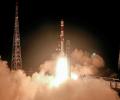
ISRO is preparing for the PSLV-C62 mission launch on January 12 from Sriharikota, carrying the EOS-N1 satellite and multiple other payloads.
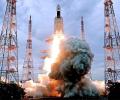
ISRO is developing a third launch pad at Shriharikota to accommodate heavier satellites and next-generation launch vehicles. The new facility will support both crewed and uncrewed missions.

ISRO has announced plans for seven launch missions by March, including the first uncrewed mission for the Gaganyaan project and demonstrations of new satellite technologies.
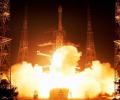
Indian Space Research Organisation is gearing up for one of its busiest times with seven more launches planned this financial year, even as India's first human spaceflight remains scheduled for 2027, its chairman V Narayanan said.
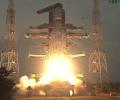
The heaviest communication satellite to be launched from the Indian soil onboard a new generation, homegrown 'Bahubali' rocket was successfully placed into the intended orbit on Sunday, the Indian Space Research Organisation said.

ISRO is set to launch its communication satellite CMS-03 from Sriharikota. The satellite, weighing 4,410 kg, will be the heaviest launched from Indian soil into a Geosynchronous Transfer Orbit (GTO).

The move follows a quiet visit by National Security Advisor Ajit Kumar Doval to the Vikram Sarabhai Space Centre in Thiruvananthapuram.

Indian Space Research Organisation's 101st mission from Sriharikota, an earth observation satellite onboard the agency's trusted Polar Satellite Launch Vehicle (PSLV) rocket, could not be accomplished on Sunday following a pressure issue in the third stage of the launch vehicle, the space agency said.

Interspersing their tweets and posts with an occasional 'Welcome buddy!' and 'Thanks for the ride, Mate!', ISRO's social media handles occasionally departed from using just technical terms to give updates about India's ambitious Moon mission Chandrayaan-3.
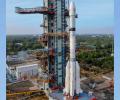
At 6.23 am on 29.1.2025, the 50.9 metre tall and weighing 420.7 ton Geosynchronous Satellite Launch Vehicle-F15 (GSLV-F15) is slated to blast off from the second launch pad carrying the 2,250 kg NVS-02 navigation satellite.

TVF deserves credit for breaking its mould of picking and sticking to favourable and comfortable genres. Space Gen could serve as a launch pad for more exciting content to come, hopes Divya Nair.
'ISRO recommended to carry out in-situ repairs or replacement and conduct a low-temperature leak test to validate system performance and integrity, before proceeding with launch.'

Twice every 12 days, the NISAR satellite will scan nearly all of earth's land and ice surfaces to measure changes in the planet's ecosystems, growth and retreat of its land and sea ice, and deformation of its crust.
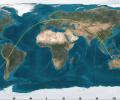
The Indian Space Research Organisation (ISRO) announced that the fourth edition of the PSLV Orbital platform Experiment Module (POEM-4), used for the space docking experiment mission, has successfully re-entered the Earth's atmosphere. The module, a repurposed spent upper stage of the Polar Satellite Launch Vehicle, impacted at 02:33 UTC (08:03 IST) on April 04, 2025, in the Indian Ocean. This successful re-entry signifies ISRO's commitment to mitigating space debris and contributing to the long-term sustainability of the outer space environment. POEM-4 had hosted 24 payloads during its mission life, yielding valuable science data. ISRO and the United States Space Command (USSPACECOM) closely monitored the module's orbit decay and predicted the re-entry date. This event showcases ISRO's proactive approach to responsible space operations.

"If we have to ensure the safety of our country, we have to serve through our satellites. We have to monitor our 7,000 km seashore. We have to monitor the entire northern part continuously. Without satellite and drone technology, we can't achieve that."

The broader theme of the performance will be -- 'Swatantra Ka Mantra - Vande Mataram' and 'Samriddhi Ka Mantra - Viksit Bharat', officials said.

The upcoming Republic Day Parade will center around the sesquicentenary of 'Vande Mataram,' featuring themed decorations, performances, and special guests.
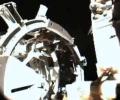
The Indian Space Research Organisation (ISRO) has successfully de-docked the SpaDeX satellites, a significant achievement that clears the path for future missions such as exploring the moon, human spaceflight, and building India's own space station. The de-docking, announced by Union Minister Jitendra Singh, follows a successful docking experiment conducted in January. The SpaDeX mission involved launching two satellites, SDX01 and SDX02, to demonstrate the docking technology in space.
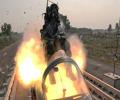
The DRDO conducted the test in collaboration with the Aeronautical Development Agency and Hindustan Aeronautics Limited.
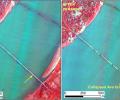
ISRO's Cartosat-3 satellite captured images of the damage caused by the 7.7 magnitude earthquake in Myanmar on March 28. The images show significant damage in Mandalay and Sagaing cities, including the complete collapse of the historic Ava (InnWa) Bridge near Inn Wa City. The earthquake also caused cracks and ground ruptures in the flood plains of the Irrawaddy River.

Meanwhile, Musk said some parts of the ISS were "simply getting too old and obviously that risk grows over time."
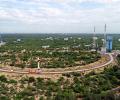
The Polar Satellite Launch Vehicle (PSLV) in its 63rd mission, would carry the earth observation satellite (EOS-09) which would be capable of capturing high-resolution images of the Earth's surface under all weather conditions.
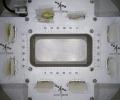
The Indian Space Research Organisation (ISRO) has announced that cowpea seeds sent to space onboard the PSLV-C60 POEM-4 platform have successfully germinated under microgravity conditions, marking a significant milestone for India's space program. This experiment, known as CROPS (Compact Research Module for Orbital Plant Studies), aims to understand how plants grow in the unique conditions of space, which is essential for future long-duration space missions.

'Our problem is not a budget deficit but a trust deficit. We need to trust our institutions and industries to innovate and lead. That is the way forward for India.'
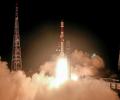
The two Space Docking Experiment (SpaDeX) satellites that the Indian Space Research Organisation is hoping to unite are at a distance of 1.5 km and will be brought much closer on January 11, the space agency said on Friday.
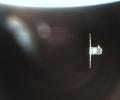
The Indian Space Research Organisation (ISRO) has successfully performed the docking of satellites as part of the Space Docking Experiment (SpaDeX). The docking was achieved after a series of maneuvers, including a trial attempt on January 12. The SpaDeX mission, launched on December 30, 2024, aims to demonstrate in-space docking technology using two small spacecraft. This technology is crucial for achieving complex mission objectives that require multiple rocket launches.
India took another leap in space infrastructure with the foundation stone laid for a new launch pad at the country's second rocket port in Kulasekarapattinam.

India and the US on Wednesday marked their maiden space collaboration with the successful flight of a GSLV rocket that placed an earth observation satellite, jointly developed by the two space agencies, in a precise orbit.

For the first time in India, the facility enables 3D printing of aerospace and rocket components up to one metre in height.

The 4,700 kg GSAT-N2 High-throughput (HTS) satellite has been injected into the desired orbit, NewSpace India Limited (NSIL) said in a series of posts on microblogging site 'X.
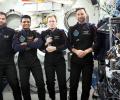
After 18 days of experiments, Shubhanshu Shukla and the Axiom-4 crew are set to return to Earth, marking the end of their mission at the International Space Station.
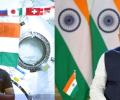
The interaction is planned via a telebridge set up at the U R Rao Satellite Centre in Bengaluru, said the Amateur Radio on International Space Station (ARISS), which facilitates interaction of school students with astronauts on the orbital laboratory.
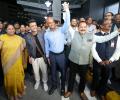
Astronaut Shubhanshu Shukla returns to India after his mission to the International Space Station (ISS). He was welcomed by Union Minister Jitendra Singh, Delhi Chief Minister Rekha Gupta, and ISRO Chairman V Narayanan. Shukla is expected to meet Prime Minister Narendra Modi and participate in National Space Day celebrations.

Astronaut Shubhanshu Shukla will undergo a rehabilitation program after returning from an 18-day mission to the International Space Station (ISS) as part of the Axiom-4 mission. The mission involved various experiments and research activities.

Two modules published by the NCERT, Swadeshi: Vocal for Local (for middle stage) and Swadeshi: For a Self-Reliant India (for secondary stage), carry excerpts from the prime minister's Independence Day address in which he stressed that self-reliance would drive India's journey towards a Viksit Bharat.
'The solution is to replace, clean up, retest and proceed.' 'There is nothing to worry about if corrected.'
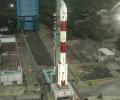
The test conducted on Saturday in collaboration with Thrust Tech India Limited saw the rocket ascend 1.1 km at 5:14:33 PM, a complete success.

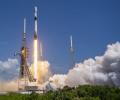
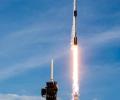
SpaceX's Falcon-9 rocket was scheduled to blast off from the Kennedy Space Centre in Florida on Tuesday evening.
 © 2026 Rediff.com - Advertise with us - Disclaimer - Privacy Policy - Sitemap - Feedback - About us - Terms of use - Grievances